

Reaching for the stars…
Some time ago I started a new project after discovering a beautiful church not far from where I live, St Marys church in South Dalton in East Yorkshire. After driving around one evening during an aurora alert, desperate to find a new location I spotted the church in the distance. And what a stunning church it is too. I am not religious at all, but standing in front of it seeing the tall slender Neo-Gothic tower reaching up into the night sky was quite an experience, almost spiritual.
It became one location I visit during special night events, the Milky Way rising behind it, the Aurora, a star trail image, and now the latest captured a few weeks ago, a display of noctilucent clouds, Latin for ‘Night Shining’.
The magic of the Northern Lights

Northern Lights behind the church OM3 7-14 Pro
This is the image that made me consider making a project out of the location. A project is a useful thing to do, it can focus the mind on a specific theme, technique, subject, story or indeed anything you want it to be, whether it is something you intend to make public or just for your own personal reasons.
I really needed another location for shooting the aurora, we have been lucky the last few years to have so many visits by Lady Aurora. Usually I go to Flamborough Head because it is reasonably close, the skies are quite dark at Bortle 4, and the headland looks north. But I can’t go there every time, it gets boring.
The church is visible from a distance from the main road so I went to check it out. It is actually a beautiful building too, I was hoping to find some exciting history, some legends or folklore about it, but unfortunately it’s only 150 years old and was built to look gothic. But I was delighted that there is actually a good view north, but only from the cemetery; there are houses and trees obstructing the view. That meant being close and having converging verticals with a wide lens, would it work?
What do you think to the converging verticals? A wide lens will always distort perspective like this unless held parallel to the subject, but for me it adds to the drama and the height of the spire.
Back there one night when the aurora paid a visit. It was a long night waiting three hours but eventually she showed at 3am. I did wonder if I would be noticed by any residents in the tiny hamlet, standing in a cemetery at night with a head torch isn’t something you see every day, and I have been visited by the police before doing another night image. An explanation of what I was doing and it was fine, they left me to it. One night at a petrol refinery on a public road security tried to confiscate my camera accusing me of industrial espionage. It was sorted when the police came, they told the security guard he was ‘over-reaching’. I could see written all over the policeman’s face what he actually wanted to say. So yes I have been accused of being an undercover spy.
But imagine the scene if you will, looking up at the tall tower reaching up into the night sky, it was a ‘wow’ moment and it was almost spiritual. I decided the distortion actually added to that feeling, and this is when I made the decision for it to become a project
Milky Way
A similar composition, this time with the Milky Way rising in the background. Using PhotoPills told me the core was not going to be visible, however there was enough to create a beautiful image I’m really pleased with.
I have no idea where the illumination on the spire came from but I was grateful for it, it lifted out of the shadows without me having to light paint it.
I am very aware of this being a cemetery so if you find yourself in a similar location, be respectful and don’t trample all over the graves. This was right on the edge so I was not standing on any.

Milky Way OM3 7-14 Pro
Star Trails
This viewpoint actually faces north which was ideal for a star trail image because the North Star (Polaris) is visible in the frame and quite close to the spire. Using Polaris means the stars will rotate around it. Other patterns will form if Polaris isn’t in the frame, arcs stretching across the image, usually in two directions with a wide lens, but this was a lucky find having Polaris in such a great position. Patience is needed, this image took 90 minutes.
It was a cool night, not freezing but still quite chilly. Remember you’ll need a lens warmer and a battery pack to stop dew forming on the lens element.

Star Trails OM3 8mm Fisheye f2
Noctilucent Clouds – ‘Night Shining’
The latest image taken only a week ago, a fabulous display of Noctilucent Clouds (NLC’s). The name comes from Latin for ‘Night Shining’ and if you’ve seen them you’ll know it describes them perfectly. They are cirrus clouds, but much much higher, and appear to glow and shimmer at night. They are quite rare and they are just as beautiful to see as the Northern Lights.
They are formed when moisture reaches the mesosphere, the highest part of our atmosphere approx 60 miles high, right on the edge of space where temperatures drop to -130c. The moisture freezes to ice forming the wispy tendril like clouds. Scientists believe the moisture turns to ice around space dust, or dust left behind by meteors. If this is the case what we are actually seeing is the remains of visitors from outer space.
NLC’s are ice clouds and meteor dust that are still illuminated by daylight at night!
They glow because even after the sun has set below the horizon the NLC’s are so high sunlight can still reach them. When other clouds and the landscape is in the shadow of night NLC’s are still in daylight. It really is a strange and beautiful thing to see.
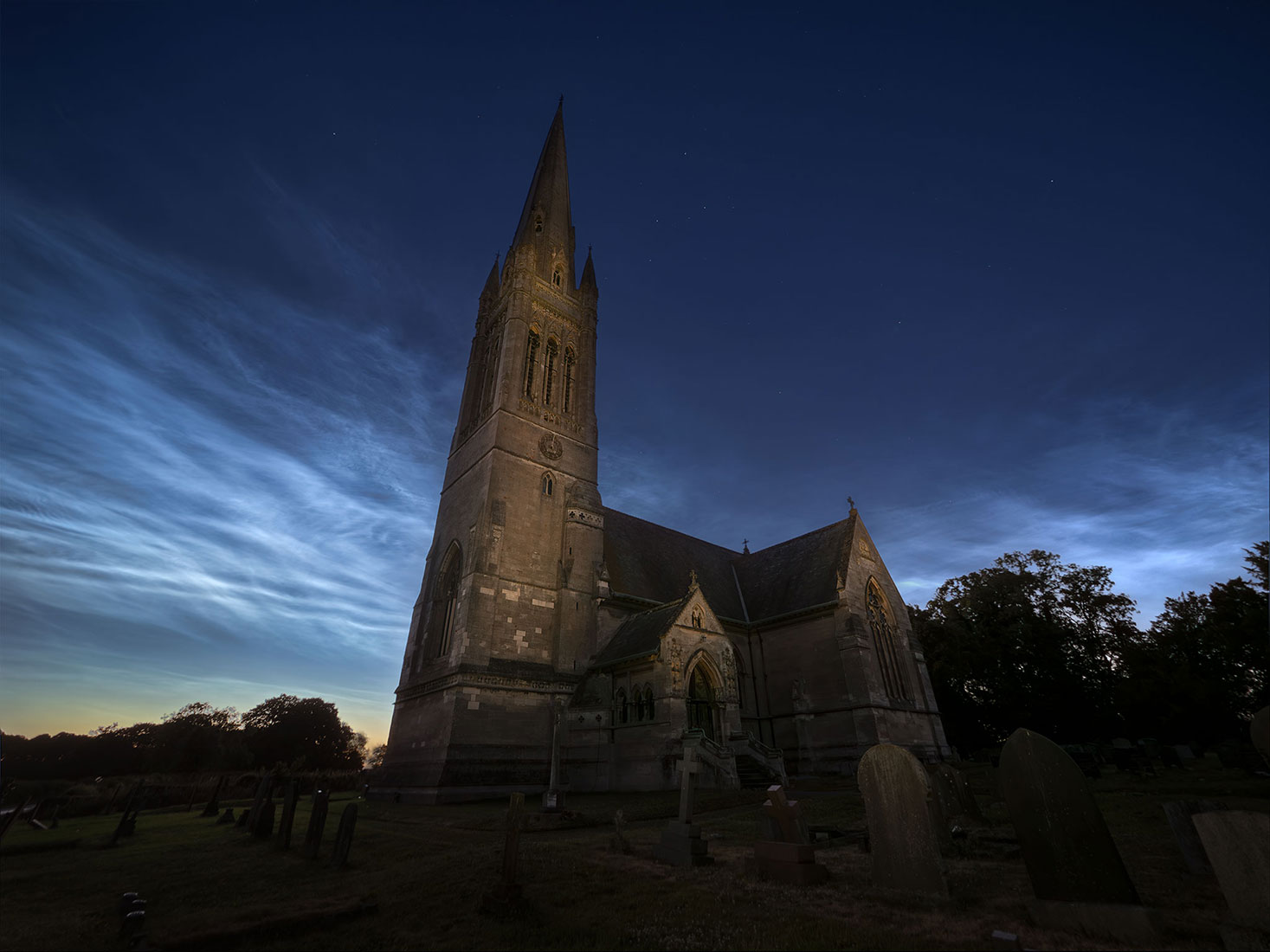
Two images, the NLC’s a single shot, the church light painted in Live Comp. OM1-II, 7-14 f2.8 Pro.
The image itself was quite simple, firstly setting my composition and using Night LV to see, then shooting a few shots until I was happy with the exposure. They move slowly so I took a number of frames in Manual to nail down the exposure, 1.6s at f2.8 ISO 200, there was no need to increase ISO because the clouds did not move the slightest over the exposure. Then it is just a case of taking shots until I was happy with the form of the clouds which worked well appearing to radiate outwards from behind the church. Cassiopeia is also visible just at the side of the steeple.
Unlike previous shots there was no artificial light on the steeple this time, so the last shot was taken in Live Composite and light painted with a torch.
Care is always needed when light painting, being careful not to overdo it and building it up slowly with a torch that is not too bright. For a shot like this where the main objective is the sky I would always leave the light painting to last; you need the sky first just in case it’s transient and will fade, then take time over the light painting. The frames are then combined in PS using masks and brushes.
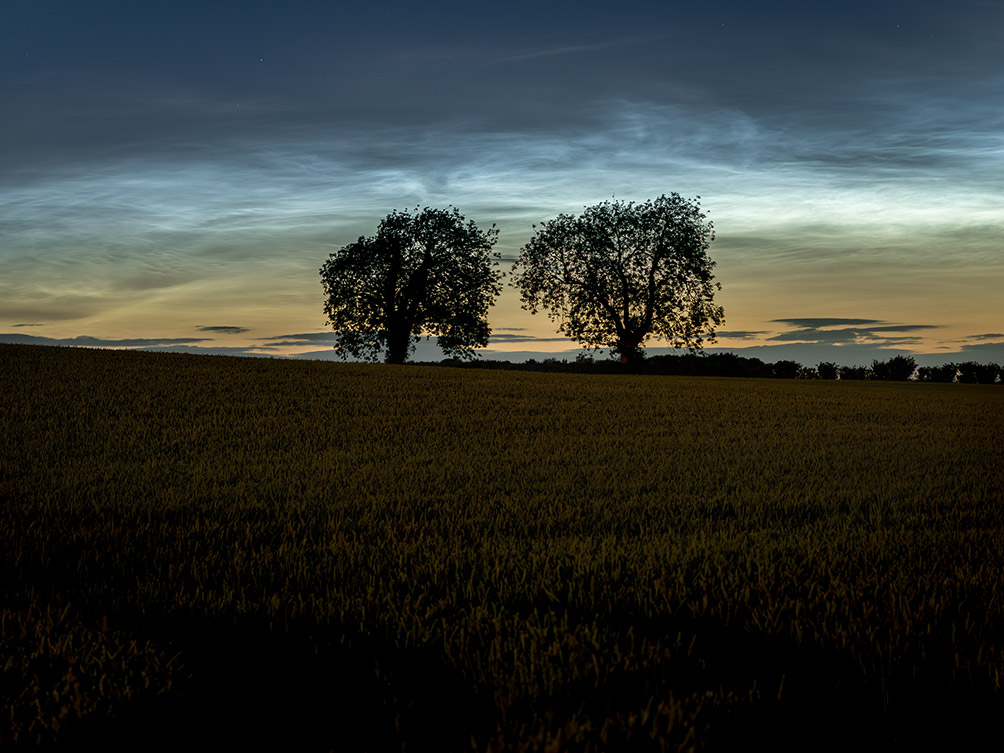
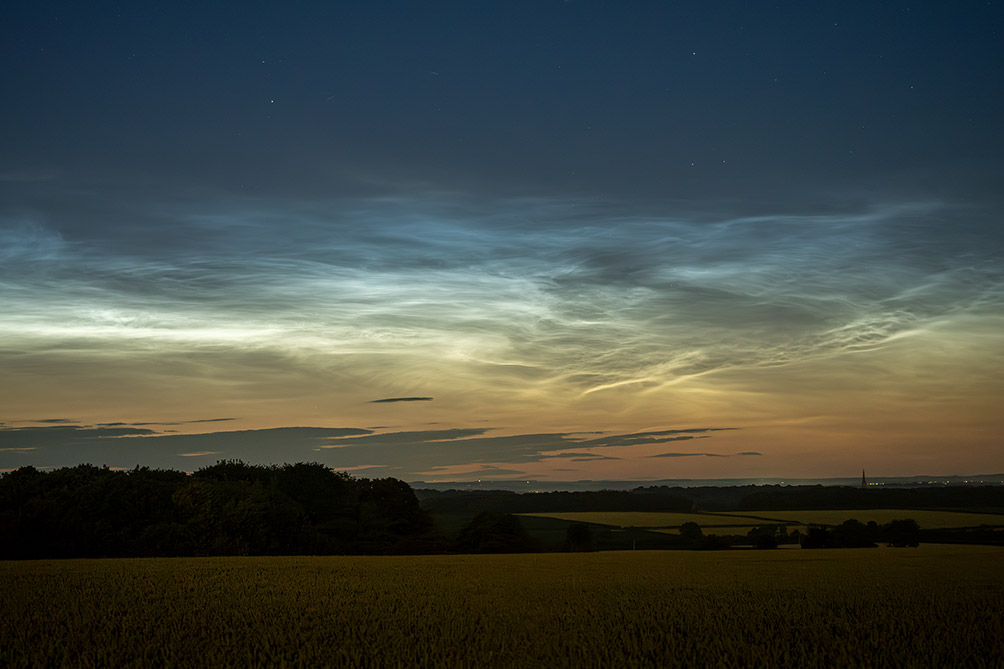
A couple of trees and the church spire visible in the distance, OM1-II 12-40 f2.8
Facebook Alerts
It started at 11:30 pm when I saw I saw posts in a few Facebook groups I am a member of, one being ‘Aurora Hunters UK & Iceland’, people where posting images they suspected were NLC’s. I couldn’t see anything outside, despite all the light pollution living on the outskirts of the city, nothing at midnight, then 12:30am I saw a glimmer!
That’s all I needed. My backpack is always ready, I threw in the 7-14 and the 12-40 Pro and a small pouch I have with a lens dew heater with battery pack and dashed off. But where to go? Flamborough Head would have been good but I wanted to stay local so I headed off to ‘my tree’.
‘MyTree’
My Tree (we all have one) is a small Hawthorne 15 minutes drive away, one I’ve used previously for a star trail image. There is light pollution from a small hamlet in the distance which I don’t mind because it adds some interest, so that’s where I went in eager anticipation.
But that was a rookie mistake.
I forgot it was in a field of wheat and when I got there the crop was up to my waist despite the heat of this summer and lack of rain. I could not even see the bottom of the tree trunk.

Moonrise
I drove around looking for a few compositions using trees and general scenes to capture the NLC’s close to St Marys church.
In one field, entering through a tractor entrance and following the lines to avoid damaging the crops I could see a glow on the horizon. It was the moon rising. This is one of the bonus shots you often get which I’m actually just as pleased with; it looks like dawn and captures a moment in time I will remember. The lines lead in to that beautiful glow of the moon, balanced by the small copse of trees on the horizon.
Then I got a call at 2am, it was my dear beloved ‘The boss’.
“Where are you??”
“In a field”
“Why are you in a field?”
“Shooting Noctilucent clouds”
“Right. See you in the morning.”
My brevity was because I was ‘in the moment’, and of course she didn’t know what NLC’s are, nor did she want to know, I know that :)
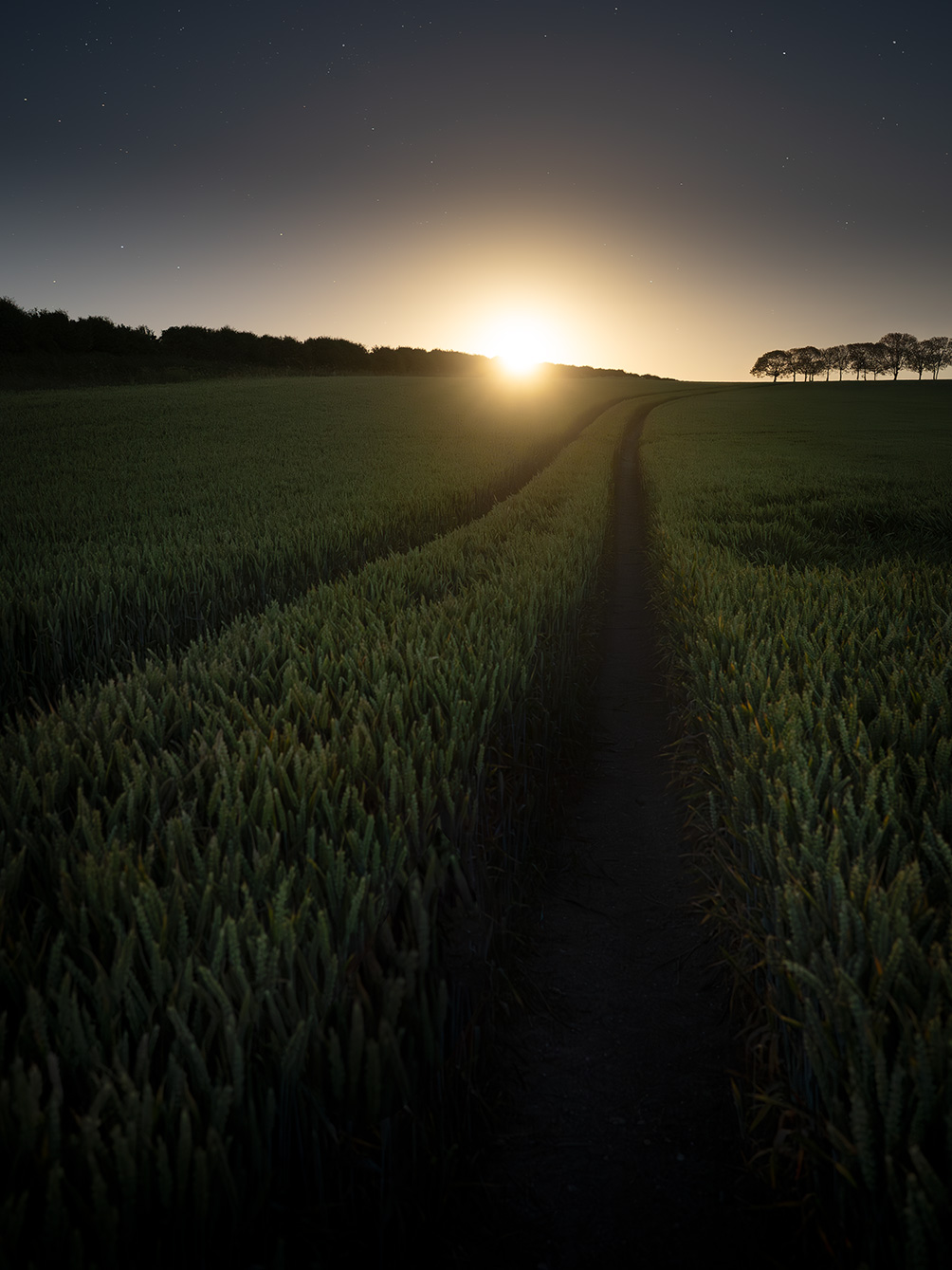
Moonrise, OM1-II 12-40 Pro f2.8
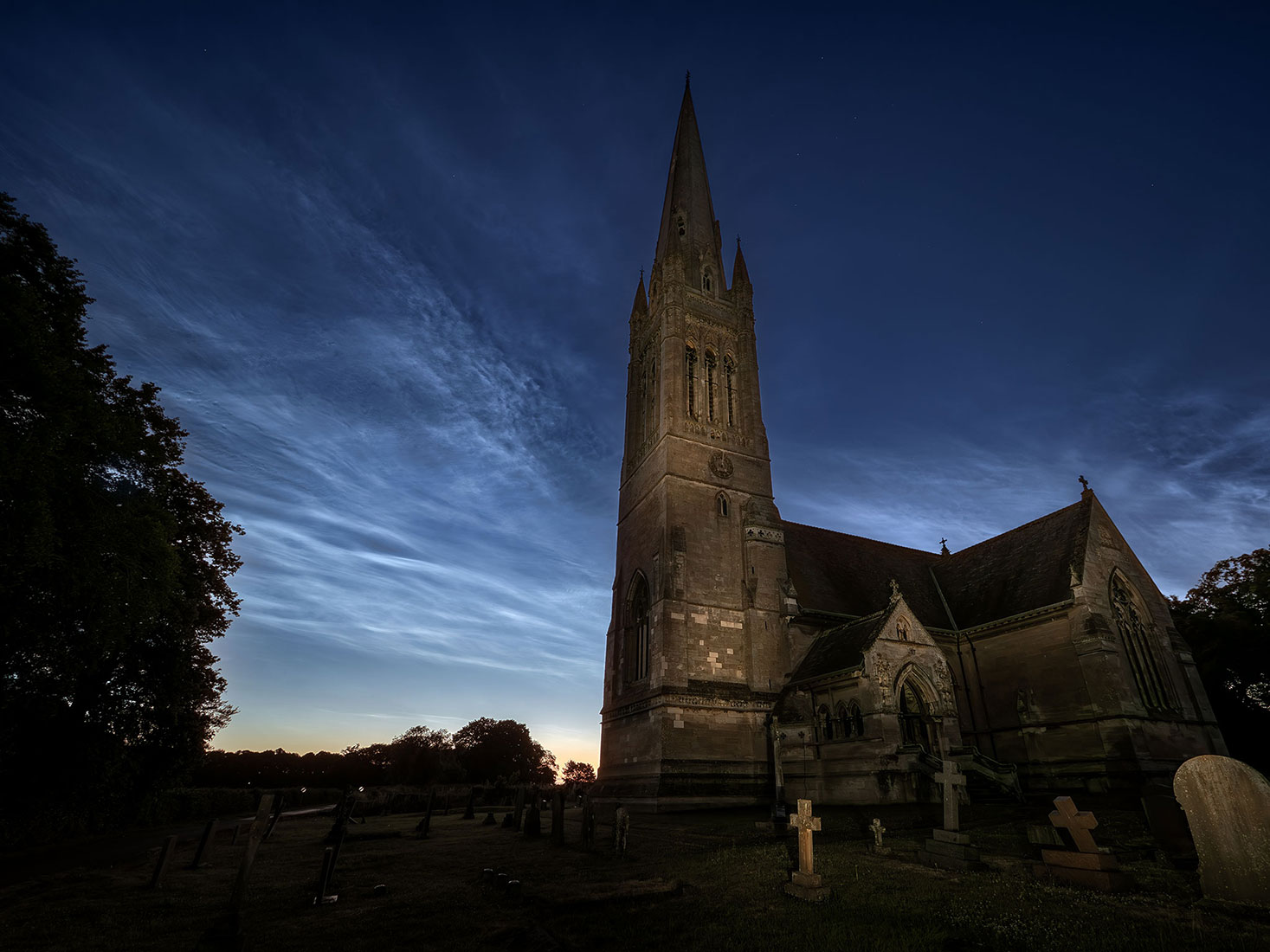
OM1-II 7-14 Pro f2.8
So after a few random images I arrived at St Marys and captured the first image at the start of this post. And another image this time reducing the amount of distortion on the steeple, again light painting for some detail on the front and the vestibules.
Personally I prefer the first image with the steeple central, even though the vertical are more distorted. It’s always worth experimenting. After this shot it was the end of another successful night shooting. I do love being out at night in the peace and quiet, knowing everyone else is slumbering, there’s something therapeutic about, even though you know the next day is going to be a challenge with the lack of sleep.
The drive home was greeted with the first light of dawn. Driving down long straight country lanes it was like playing dodgems with the number of rabbits and deer out. Why do they always insist on running away ahead instead of to the side or even backwards?
I hope you enjoyed this read and thanks for looking, and feel free to leave comment. Next I really want to get an electrical storm, lightning would be really good. There was a storm recently, Devon, Northern Ireland and Scotland were hit with thousands of strikes, but it didn’t arrive near me until 9am the next morning. And although I don’t think I can improve on the star trail image I can always hope for better Milky Way and aurora.
Phil
If you use OM System / Olympus ad you’re interested in night photography please check out my guide, it is packed with tips, tricks and techniques for shooting Star Trails, Aurora, Milky Way and the moon, with lots of example images too.
Wonderful shots Phil
I actually saw these last night, it seems things really are changing, what with Aurora and now maybe NLCs too? I particularly liked your image of the church, it gave a focal point rather than just a shot of the sky. Keep up the good work!
A good read Phil
I have followed your work for some time now and always find your images very rewarding to view. And you are so right about having a project, I have had a number over the years, some quite cliche I admit but nonetheless they are personal to me. Most images will never see the light of day, they are just for me to explore, but it can be very rewarding.